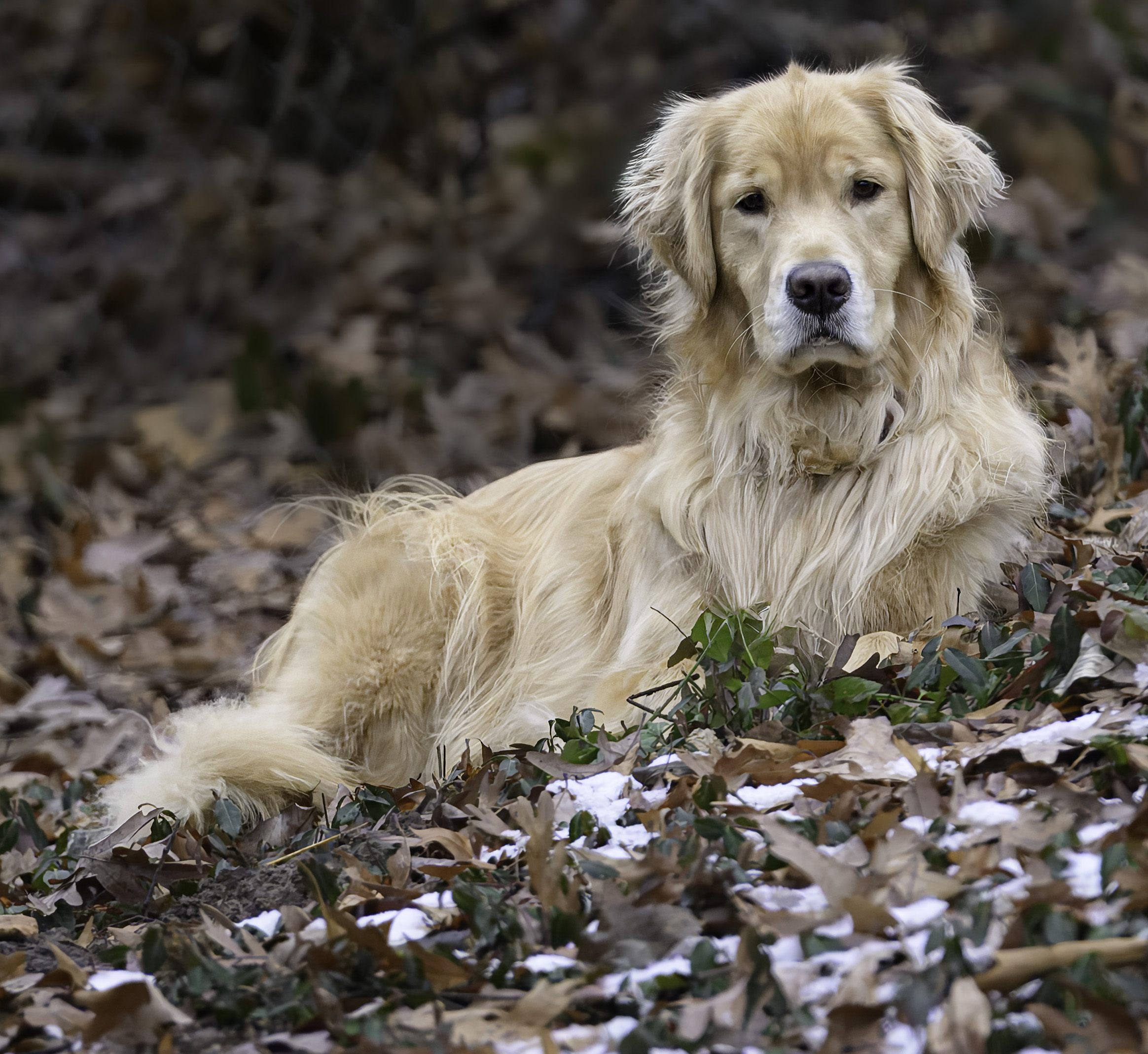
Reading dog body language is essential to a successful photo session.
Capturing your dog’s genuine personality on camera isn’t just about having top-notch equipment, a scenic location, or beautiful lighting. It’s about noticing the signals your dog sends, and adjusting in real time to match its emotional state.
As a professional pet photographer, our charge is to be where the dog’s feet are. It’s the the difference between a generic snapshot and a portrait you’ll treasure.
A relaxed dog reveals it in every movement, from the natural position of its ears to the gentle rhythm of its tail and the calm in its eyes. An anxious or overstimulated dog shows it, too, and the lens won’t miss it
Read more about how we make sure – no matter how long it takes – your best friend shows its best face to our camera.

What relaxed, happy dogs look like on camera
One summer morning at her home in Rogers, I photographed a golden doodle named Becca. Becca, a rescue dog that is still cautious around new people even after seven years, was timid at first. But after time to get to know us, she began gentle tail wagging and relaxed her ears forward. Her body posture was balanced.
These are classic calming signals. They’re clear signs of a relaxed dog ready to engage. In pet photography. We could then capture close-ups without tension or encourage a playful burst of energy without creating stress.
Positive cues to watch for:
- Loose, balanced body posture without stiffness
- Ears forward or at ease in a neutral position
- Tail wagging slowly at a natural height
- Soft, steady eye contact without a hard stare
- Play bow — front legs stretched forward, back end raised
- Relaxed facial expressions with a light pant
A wagging tail alone doesn’t tell the whole story. It’s the combination of posture, expression, and tail position that signals a truly happy dog.
How to recognize stress and overstimulation before it ruins the photoshoot

It’s not unusual for some dogs to need time to settle into a session. I met a rescue shepherd who avoided my gaze, kept his tail low, and licked his lips repeatedly. These cues told me he was feeling unsure.
Rather than push for immediate poses, we walked a quiet trail until his ear position shifted forward, his tail lifted to a neutral position, and his whole body loosened. Everything after that was perfect.
Common stress cues include:
- Whale eye — whites of the eyes visible
- Ears pinned back or flattened
- Tail tucked or held stiff and high
- Lip licking or yawning when not tired
- Raised hackles (piloerection)
- Hard stare or tense facial muscles
When we see these signals, we adjust by slowing the pace, moving to a calmer space, or introducing something familiar like a quick game of fetch.
Why NWA locations and lighting change a dog’s body language
Body language can shift dramatically with the environment. The same dog may look confident on a quiet trail and unsure in a bustling plaza.
- Busy settings: The Bentonville farmers’ market or the paths near Crystal Bridges can make even a friendly dog avert its gaze or display appeasement behaviors due to the crowd, sounds, and scents.
- Quiet escapes: Shady trails at Wilson Park often bring out softer expressions and looser posture.
- Lighting changes: Harsh midday sun on the open paths can cause squinting or ears angling back. Early morning or late afternoon light tends to produce softer eyes and relaxed body language.
Recognizing these patterns helps us choose the best spot — and the best moment — for each shot.
And for locations, see our updated post on dog-friendly parks in Northwest Arkansas.
Adjusting distance, pacing and angles based on body language
Reading canine communication isn’t just for understanding the dog. It is how we decide when to click the shutter and when to wait.
- Distance adjustments: A timid hound in Orchard Park in Bentonville avoided eye contact. Using a telephoto lens allowed us to get farther away without adding pressure.
- Energy management: An excited retriever at Coler Mountain Bike Preserve in Bentonville couldn’t focus with bikes passing. A short break in a quieter area helped him settle into a relaxed stance.
- Distraction control: A terrier at Lake Atalanta in Rogers was startled by joggers. Moving behind a line of trees shifted her ear position from pinned back to forward curiosity.

These decisions are part technical skill, part behavioral awareness.
Why your photographer’s dog-reading skills matter in Northwest Arkansas
There are many skilled photographers in Northwest Arkansas. But a truly special portrait — one worthy of your wall — comes from reading subtle cues like a change in tail position, ear movement, or eye contact, and responding without adding stress.
When we meet a dog, we watch for:
- Natural tail carriage when relaxed
- Baseline ear position
- Response to our first eye contact
From there, it’s like having a conversation without words — posture, movement, and expression guide the session toward genuine moments.
For a deep dive into the benefits a pro photographer offers, see our in-depth article on why hire a professional pet photographer.
Putting it together for a calm, confident photo session
Understanding dog body language is a blend of science, art, and connection. Whether it’s a joyful splash at Lake Atalanta or a peaceful moment on the Razorback Greenway, the best portraits come from dogs who feel truly comfortable.
If you want your dog’s personality to shine — ears forward, eyes bright, tail wagging at just the right height — let’s plan your session in one of Northwest Arkansas’s many dog-friendly spaces.

Todd Gurley: Better Late Than Never
Todd Gurley is a photographer who has come to the professional party late, but has had a big boy camera since he was 14.
Todd’s love of photography always had an outdoor focus. It started with sports, evolved to landscape, and then wildlife and birds.
And now pets!.
Based in St. Louis, Missouri, but an Arkansan at heart, Todd lives with his partner in crime of 50 years Sheila and about 250 pounds of dogs. They have two golden retrievers named Gracie and Ellie and one black lab named Norman. And bringing up the rear is an additional 10 pounds from Sally the rescue cat. She’s in charge if you are wondering.
Todd has this other business with his son Drew called Redbird Advisors. Oh, and he now has this website which was first discussed 25 years ago.
No wine before its time!
P.S. The photo above was taken on our way to the summit of Mt. Quandary, a 14,271-foot peak in the middle range of the Rockies, south of Breckenridge. Colorado. There are 58 named “14ers” in Colorado, the most of any state.
You must be logged in to post a comment.